Focus
France B2B E-Invoicing: 5-Corner architecture & API strategy

The upcoming French B2B electronic invoicing and e-reporting mandate represents a critical compliance and architectural requirement for international software vendors. Software platforms servicing the French market must adapt their infrastructure immediately to comply with the official timelines structured by the Direction Générale des Finances Publiques (DGFiP).
Navigating the réforme facturation électronique (electronic invoicing reform) is a top commercial priority for product teams. Meeting the facture électronique obligation (electronic invoice obligation) is no longer a future roadmap item, but an immediate operational necessity. The timeline for facturation électronique 2026 is strictly structured:
September 1, 2026: Mandatory reception for 100% of French companies. Mandatory issuance for Large and Mid-sized enterprises. (Note: Market evaluation indicates the high probability of an unconfirmed transitional grace period. While the réforme facturation électronique formally enters into force in September, operational penalty enforcement is expected to be deferred until December 1, 2026, or January 2027, pending official administrative confirmation).
September 1, 2027: Mandatory issuance for Small and Micro-enterprises (SMEs).
Product Risk: While a transitional tolerance window may temporarily suspend non-compliance penalties until December 1, 2026 or January 2027, aligning product roadmaps with unconfirmed regulatory extensions introduces critical operational risks. To guarantee full adherence to the facture électronique obligation, billing platforms must natively ingest, validate, and process French structured formats from the official launch, eliminating the risk of transactional rejection and systemic customer churn. |
Understanding the French 5-Corner model architecture
France has officially structured its electronic invoicing framework around the decentralized 5-Corner Model (De-Centralized Transaction Clearing
Ecosystem - DCTCE), scaling back the operational scope of the Public Invoicing Portal (PPF - Portail Public de Facturation). The PPF (Corner 5) acts purely as a central directory registry and tax data concentrator for the government.
All core billing transactions, tax compliance validations, and structured files flow peer-to-peer directly between private accredited platforms, known as Partner Dematerialization Platforms (Plateformes de Dématérialisation Partenaires - PDP, acting as Corners 2 and 3).
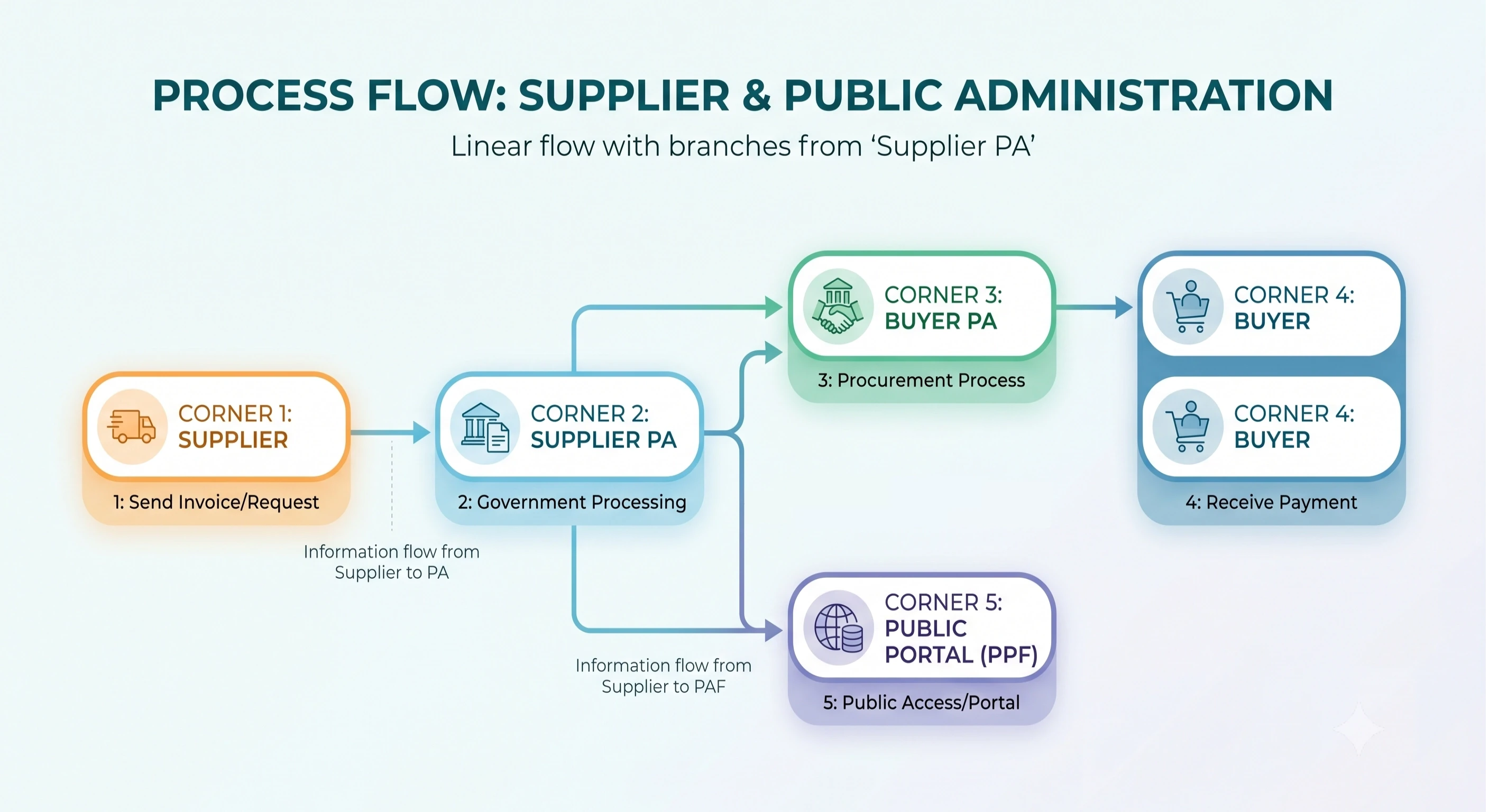
For software vendors, delaying compliance means lock-out from this network. Embedding a compliant solution ensures your platform seamlessly integrates with the electronic invoice obligation parameters, keeping your French users operational.
Mandated regulatory data streams
To achieve absolute DGFiP compliance, your platform's backend infrastructure must support two distinct regulatory data workflows without introducing friction to the user experience:
E-Invoicing (Facturation Électronique) - Domestic B2B: Exchanging structured electronic files compliant with the European EN 16931 standard. The network natively accepts three formats: Factur-X (hybrid PDF/XML), UBL, and CII.
E-Reporting (Transmission de Données) - B2C & Cross-Border: The cyclical transmission of international e-commerce, B2C transaction metrics, and payment status details directly to the French tax authority via the PDP network.
Data Compliance: processing the 4 mandatory nominal lifecycles
Unlike simple clearance frameworks where an invoice is transmitted and forgotten, compliance in France requires rigorous real-time synchronization of the document’s commercial and fiscal lifecycle. Your software database must map and transmit updates across exactly 4 mandatory nominal statuses defined by law:
Status (DGFiP) | Technical & Fiscal Meaning |
| The invoice payload is successfully submitted to the platform. |
| The invoice fails initial validation or schema validation checks. |
| The commercial buyer explicitly declines or refuses the invoice. |
| Payment has been received (critical for tracking VAT on service provisions). |
Why building a "native" french connector is a technical debt trap
Many product teams mistakenly believe they can build a quick native connector to the French network. However, software platforms cannot connect directly to the regulated network without undergoing a massive government accreditation process to become a certified PDP.
Without this accreditation, your ERP or accounting software remains a Compatible Solution (SC)—meaning you are legally blind to the network and must route through an approved intermediary.
The composable solution: one API for global Compliance
Instead of losing quarters of product velocity building single-market patches and navigating regional audits for France, Germany (XRechnung/ZUGFeRD), Italy (SDI XML), Poland (KSeF), or Belgium (Peppol), engineering teams embed
A-Cube’s unified REST API as a single cross-border abstraction layer.
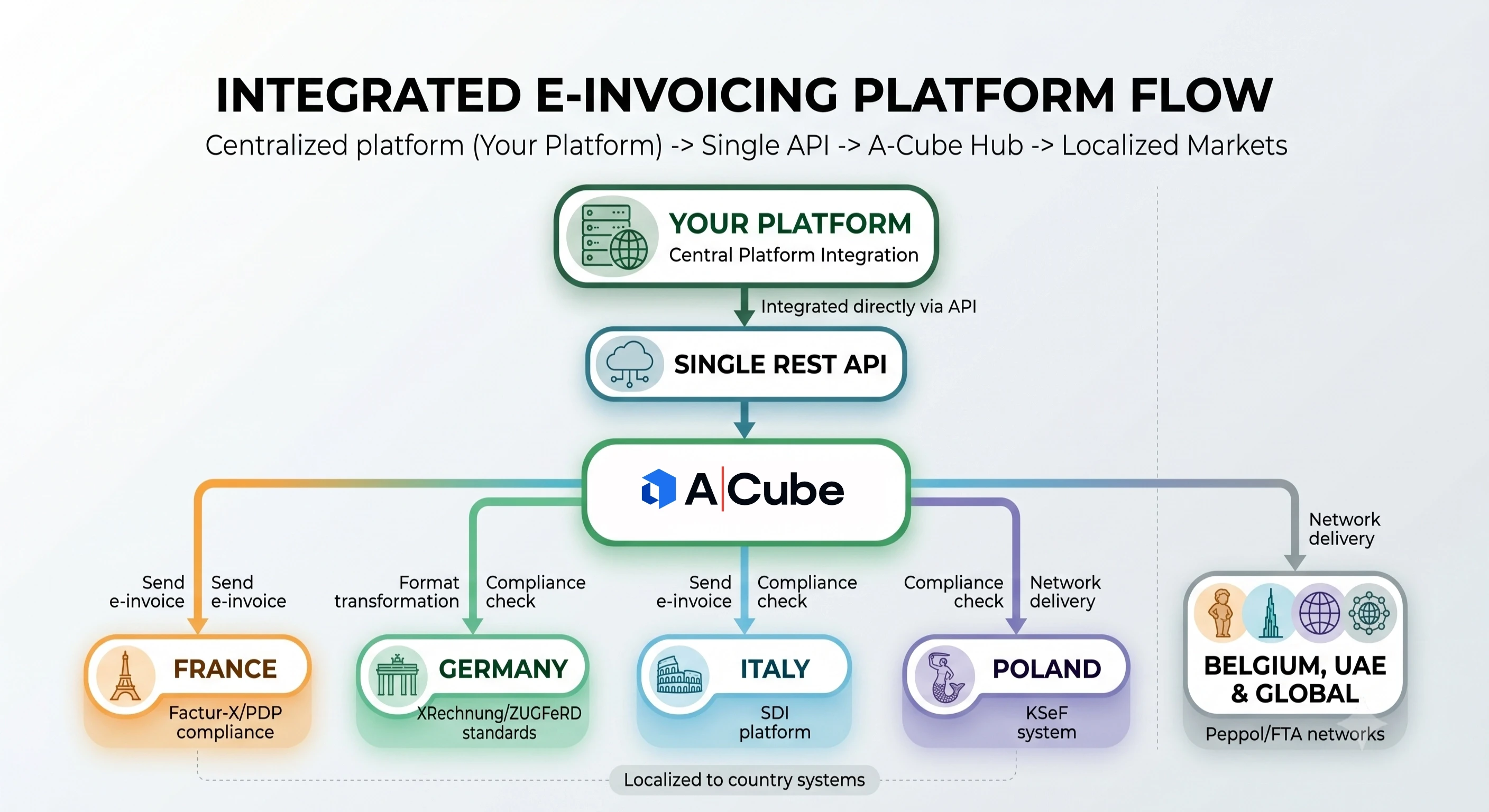
By connecting your platform to A-Cube, you instantly offload the regulatory stack:
Zero accreditation friction: access the French 5-corner ecosystem instantly through our pre-built, compliant infrastructure.
Multi-format engine: Seamless automated generation and parsing of Factur-X, UBL, CII, and localized European XML schemas.
Normalized webhooks: A-Cube maps disparate country-specific updates (like the 4 French mandatory statuses) into a single, clean lifecycle status map inside your database.
Stop building localized fixes. Explore our A-Cube French E-Invoicing Documentation and download our API schemas to scale your product across France and Europe with zero technical debt. |

