Case histories
Case study: Azerouno and document exchange with suppliers via PEPPOL
Peppol, short for Pan-European Public Procurement On-Line, is the system that enables companies and Public Administrations in different countries to exchange electronic documents, data and invoices through a certified and secure network. Over the years, the network has been adopted globally for sending business and administrative documents between companies in different countries and between them and Public Administrations. Today, Peppol covers the entire e-procurement process and is used by almost 1.5 million companies in 98 registered countries. So, while it is becoming the standard solution for B2G (Business to Government) invoicing worldwide, in B2B the experience of use, especially in Italy, is less common.
We present the use case of Azerouno which uses A-Cube’s PEPPOL APIs to manage the document sending cycle between suppliers who use their management software, but not only that. Luca Peirotti, founder and CEO of Azerouno S.r.l., tells us about it.

Can you give us a brief overview of Azerouno? What sector do you operate in, what is the size of the company and the volume of B2B transactions you manage?
Azerouno is a cutting-edge software house, founded in 2004 and already talking about Industry 4.0 in 2008, when it launched Concept/TIME, used to track timings and the progress of the workshop cycle. Over the years we have increasingly specialised in creating advanced, reliable and simple software for the metalworking, structural steel and sheet metal processing sectors. Our strength lies in looking ahead, embracing challenges, finding solutions and imagining the company of tomorrow. We have 2 offices, in the province of Cuneo and in Padua, 650 customers in Italy, and around 10,000 people who use our applications every day.
Why did you choose a PEPPOL B2B network for document exchange?
The idea came from direct experience: Azerouno has always sold its own ERPs through word of mouth and customer satisfaction, and customers have become our best promoters. It is often the customers themselves who recommend our software to their suppliers, explaining how they use it and thus helping us acquire new users. Many customers work in a network and interact with each other, so they constantly ask us: “Why don’t you do something to manage the import/export of Excel, PDF or technical and commercial documents? We send it by email now, can’t the process be automated?”. From there came the idea of creating a server-based solution with automated data exchange, using a standard format. Our goal was to enable the structured exchange of documents linked to supply chain processes for Concept customers, but because a standard was adopted, the solution opens up scenarios in which the parties use third-party ERPs such as SAP or Microsoft Business Central.
What is the most common use case for this solution?
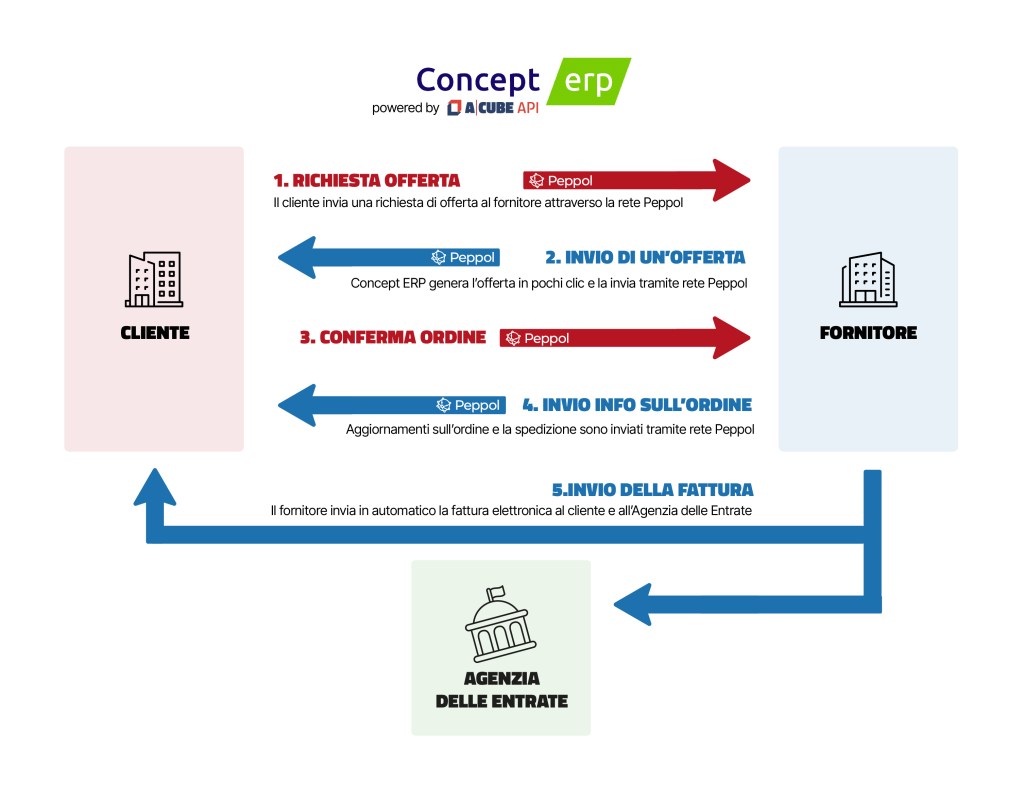
Our goal is to digitise the entire process, from the request for quotation to the generation of the DDT, eliminating manual data entry and errors resulting from management via email with PDF attachments. In the typical flow, production starts a purchase request that generates an order sent to the supplier via the Peppol network. The recipient’s software automatically receives the already coded documents, complete with any attached technical drawings. Within our ERP, Concept, the user receives the request and, with one click, can generate the quotation, create the items and send the quote through the Peppol network. The supplier then receives an already priced order and can in turn generate and send the confirmed order via the same network, complete with processing times, planned delivery date and work-in-progress updates. When the goods are ready, availability for order fulfilment is notified. At present, all this happens by email via a notification module, but soon it will be replaced by a Peppol message. At the time of dispatch, the DDT is then generated, uploaded to the digital documents and completes the RDO–DDT cycle. Finally, the supplier issues the invoice with the data already prepared directly from the order: the company that requested the order receives it and automatically reconciles it in the system, closing the cycle.
What difficulties did you encounter during the creation of this solution? Sending and receiving documents will not happen only between those who use our ERP Concept but potentially with any software. Some fields in the PEPPOL standard naturally need to be interpreted and mapped so that they match correctly across different platforms; we have encountered some issues in this regard, which we clarified through the documentation. We expect to be able to release this solution within the year so that it can be tested in some contexts.
These features also become an open door to Europe for your customers…
Absolutely. The customer enabled to receive and send this type of order will have their own identifier and will fully become part of the PEPPOL network. So they will already be ready to exchange with foreign customers and suppliers in Europe and wherever this standard is being adopted. It also goes in the direction of the ViDA directives, “VAT in the Digital Age”, the reform introduced by the European Commission with the aim of modernising VAT management in the digital economy and increasing the traceability and transparency of international financial operations.
How was the experience of integrating A-Cube’s Peppol APIs?
It was all very simple and we found really clear and comprehensive technical documentation available, but we already knew the quality of A-Cube’s solutions because, as Azerouno, we have been customers since 2018, when we integrated the electronic invoicing APIs.
To find out more:
Azerouno’s website
A-Cube’s APIs for the PEPPOL network